Author: Jonathan

  • Double dropped kerb and block-paved driveway in Thatcham

    Double dropped kerb and block-paved driveway in Thatcham

    Recent project / Thatcham, West Berkshire

    Double dropped kerb and block-paved driveway in Thatcham

    Two neighbouring properties. One coordinated access upgrade. We installed a double dropped kerb in Thatcham and transformed a worn front garden into a new block-paved driveway.

    Neighbouring residential properties · Thatcham, Berkshire

    Completed double dropped kerb serving neighbouring properties and a new block-paved driveway in Thatcham
    The finished project

    18 m²

    New block-paved driveway

    19 m²

    Approximate crossing area

    Double

    Dropped kerb for neighbouring properties

    01 / The transformation

    Two neighbours.
    A better way in.

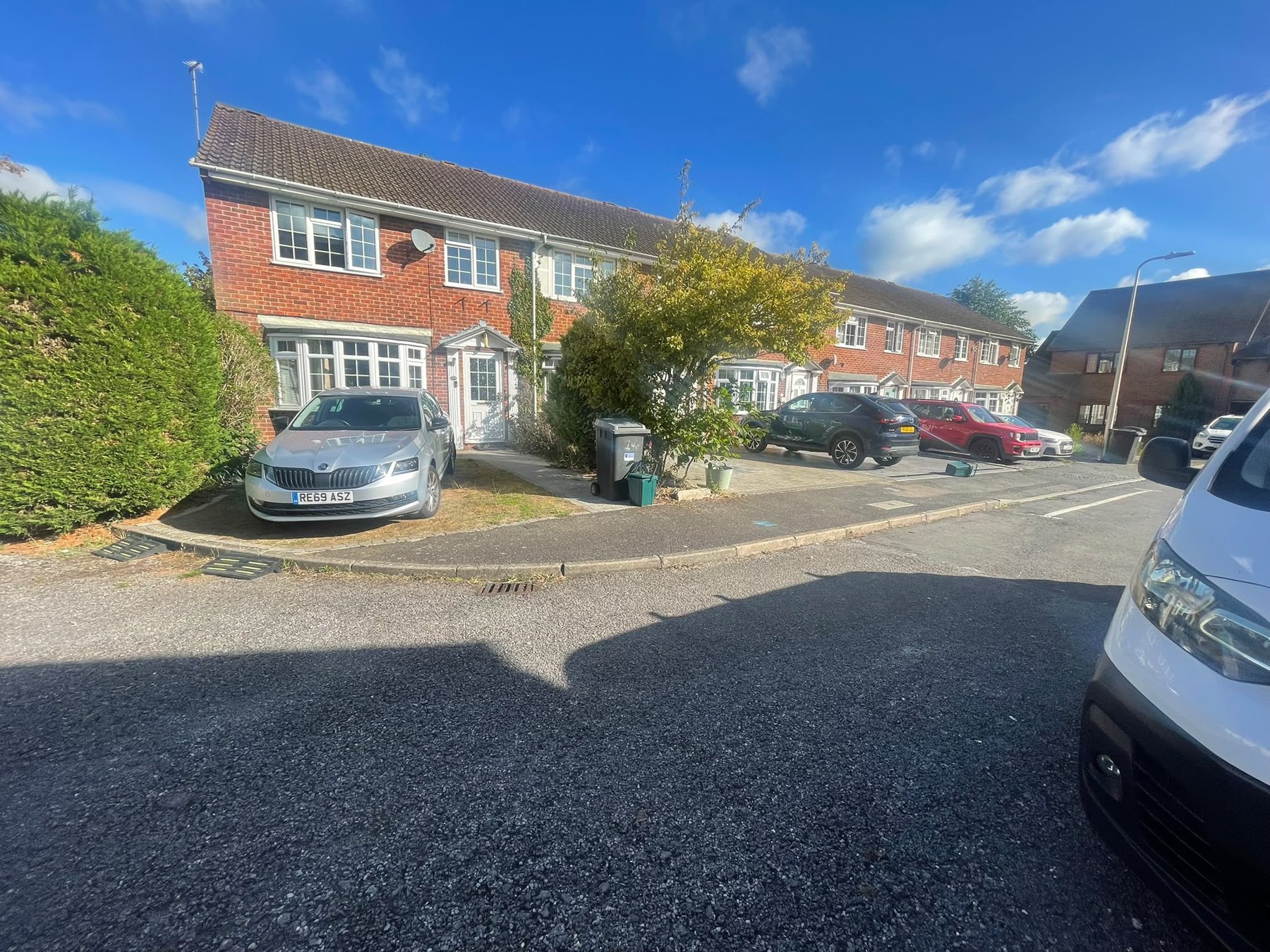
    The before photos show a grassed parking area, a narrow path and the raised kerb along the frontage. Our work brought the access together: a neighbouring double dropped kerb across the two properties, fresh tarmac to the crossing and an 18 m² block-paved driveway at one home.

    Neighbouring properties in Thatcham before the double dropped kerb and driveway work
    Before: the original frontage, grassed parking area and raised kerb across the neighbouring properties.

    Before

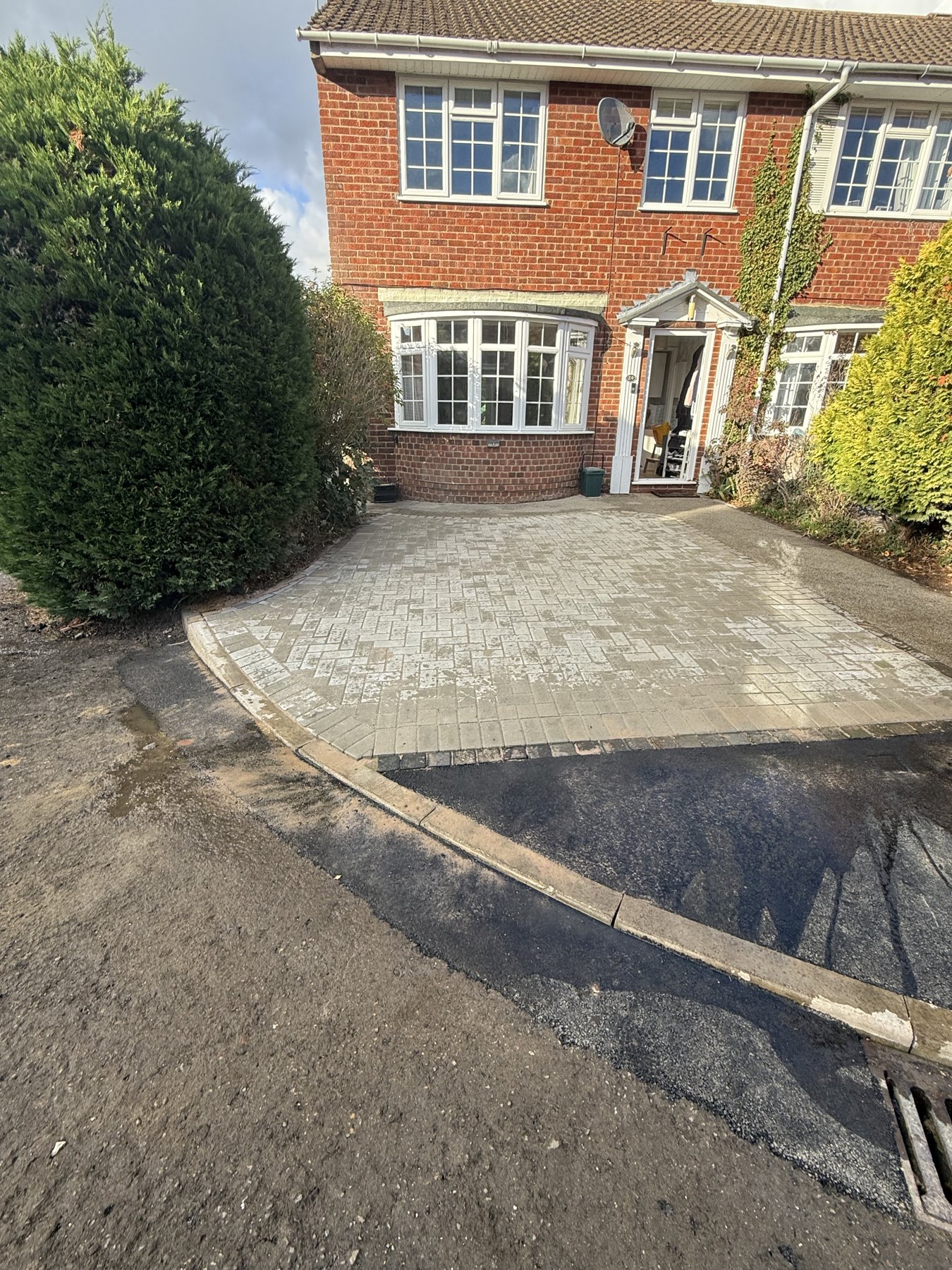
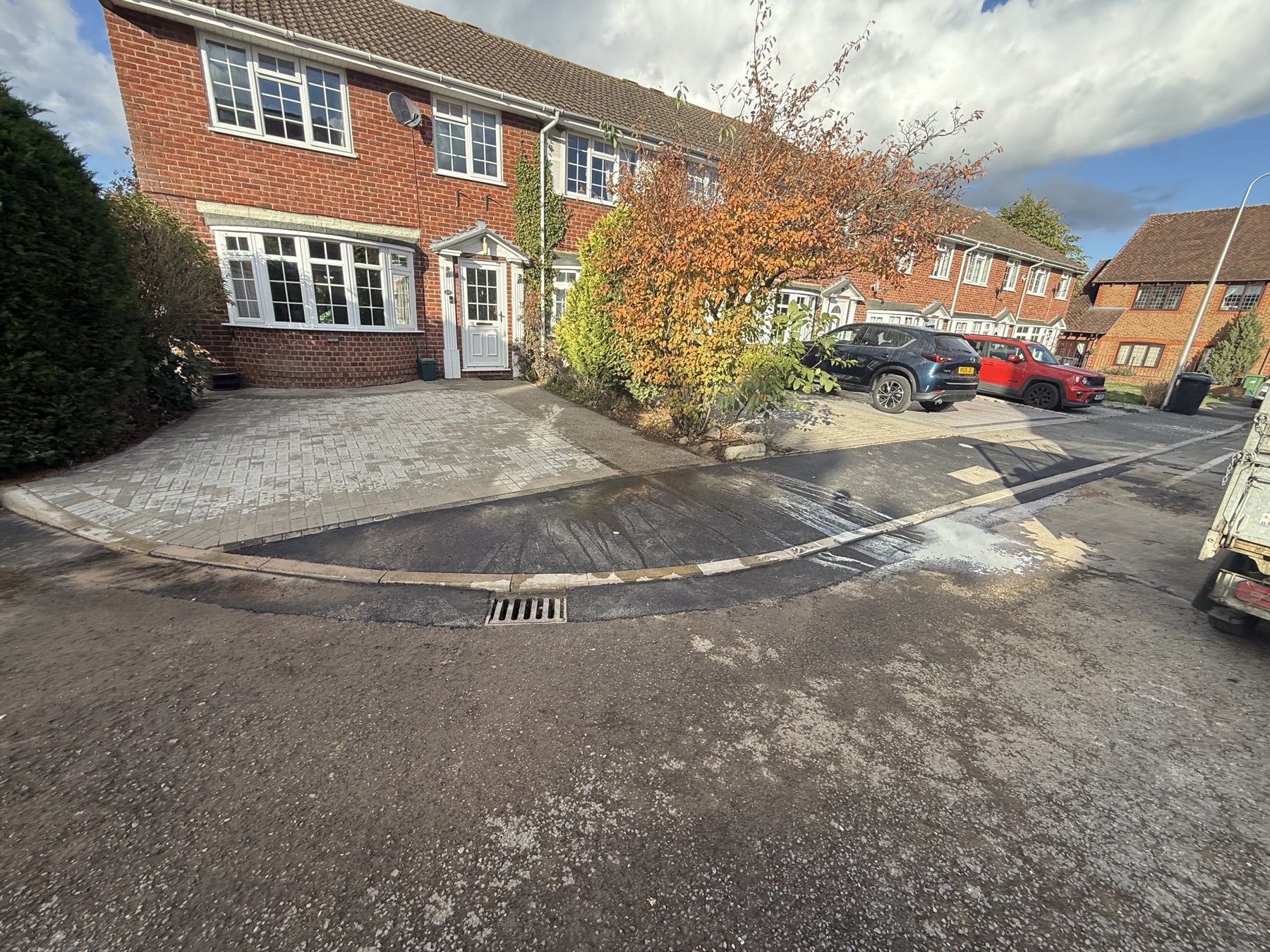
    Completed double dropped kerb and new block-paved driveway in Thatcham
    After: the new block-paved driveway and completed double dropped kerb serving the neighbouring properties.

    After

    02 / Beneath the surface

    A fresh finish starts
    with the foundation.

    Remove and prepare

    We excavated approximately 18 m² for the new driveway to a depth of 230 mm. The approximately 19 m² crossing area was excavated to the relevant highway specification, with waste removed from site.

    Build the foundation

    The driveway was prepared with compacted Type 1 limestone sub-base, with geotextile where required for separation and stabilisation. A 30–40 mm sharp-sand screed formed the laying bed for the blocks. Type 1 sub-base also supported the crossing.

    Form the double dropped kerb

    We installed the low kerbs and transition on a GEN1 concrete foundation to form the neighbouring double dropped kerb. One BT cover and two water stopcock covers were adjusted to suit the new levels.

    Lay the finished surface

    Marshalls concrete block paving was laid to the driveway, with kiln-dried jointing sand brushed in and a power-plate finish. The crossing received a 40–50 mm layer of 6 mm tarmac, compacted with a roller and power plate.

    Finished Marshalls block-paved driveway in Thatcham with a bordered edge
    The completed block-paved driveway, with a defined border and the new tarmac crossing at its entrance.

    Materials used

    Type 1 limestone sub-base · sharp-sand laying bed · Marshalls concrete block paving · kiln-dried jointing sand · low kerbs on GEN1 concrete · 6 mm tarmac.

    Completed tarmac crossing and double dropped kerb across neighbouring properties in Thatcham
    The finished double dropped kerb and tarmac crossing along the neighbouring frontages.

    Completed crossing

    Highway licence paperwork

    The paperwork? We handled it.

    We completed the highway licence paperwork free of charge, handling the application administration and liaison with the highway authority. There was no Irvine Surfacing administration charge; council and highway application fees were separate.

    03 / The finished details

    A new driveway.
    Joined-up access.

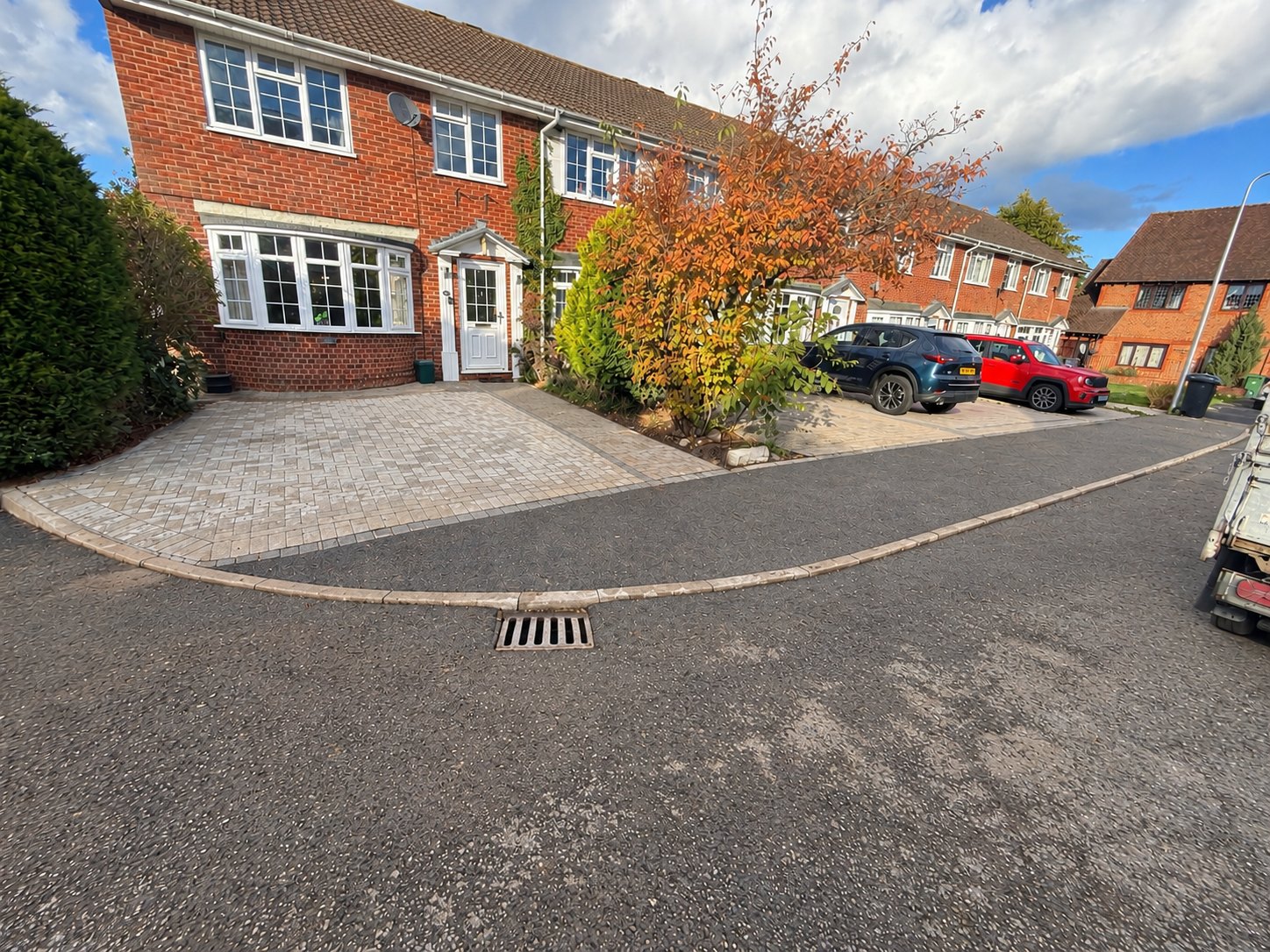
    The new paving creates a defined parking space, with a neat border alongside the existing path and planting. At the road, the lowered kerb and renewed tarmac crossing serve the neighbouring properties as one coordinated project.

    Completed block-paved driveway and neighbouring double dropped kerb in Thatcham
    Finished: block paving laid in a herringbone pattern with a contrasting border.

    Finished

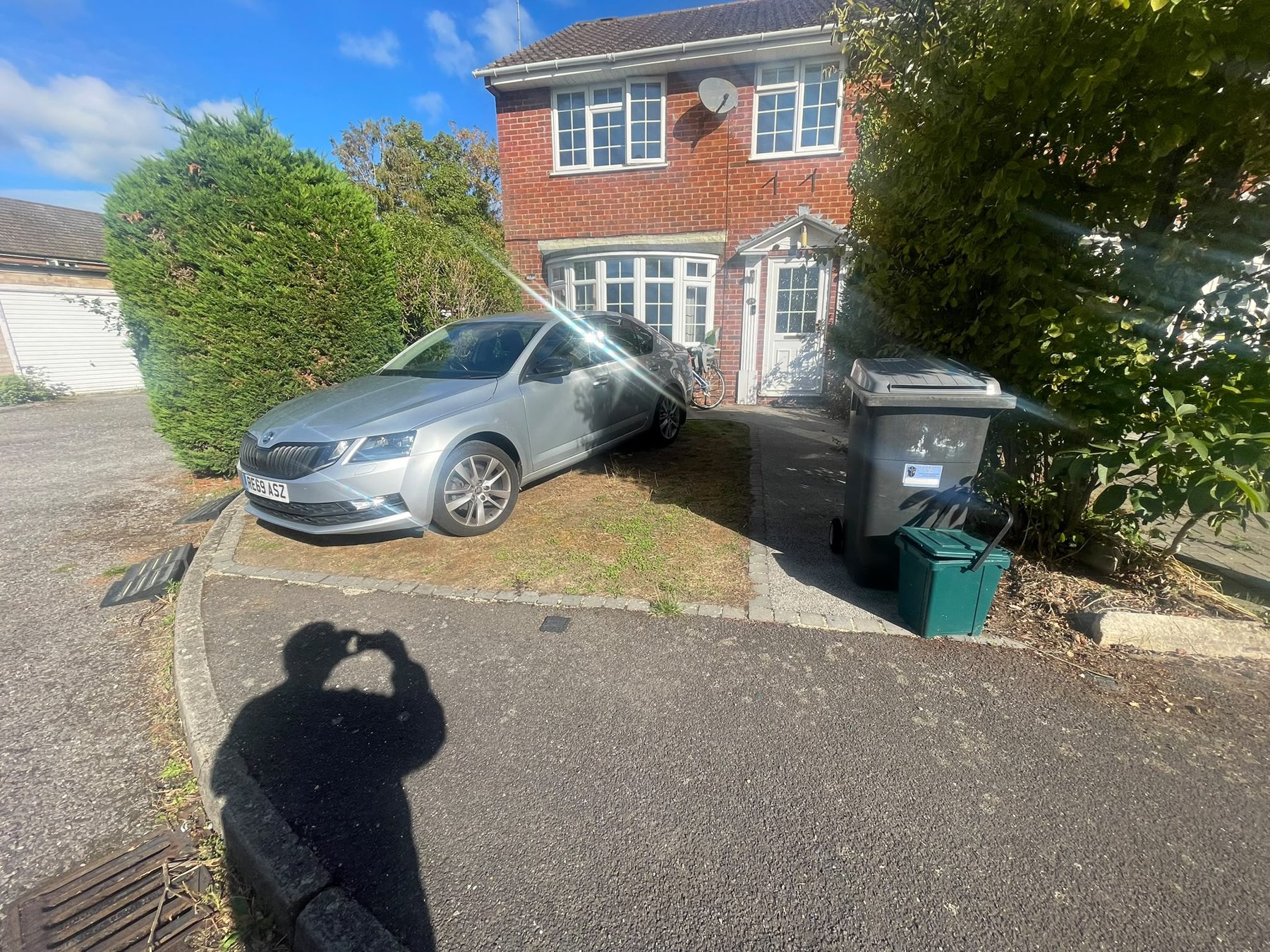
    Front garden and grassed parking area before the new Thatcham driveway
    Before: the worn grass parking area and existing path, prior to the new block-paved driveway.

    Before / The detail

    This Thatcham project combined the visible transformation of a front garden with the less visible preparation beneath both surfaces—and the highway licence paperwork needed to organise the crossing works.

    Let’s talk about your driveway

    Need a dropped kerb or a new driveway?

    Planning work in Thatcham or the surrounding area? Talk to Irvine Surfacing about a driveway, a dropped kerb, or a coordinated project with your neighbour. We can assess the site and explain the work and application process.

    Explore our block paving services in West Berkshire and dropped kerb services, or see more completed surfacing projects.

  • Tarmac driveway repair in Southampton

    Tarmac driveway repair in Southampton

    Recent project / Southampton, Hampshire

    Tarmac driveway repair in Southampton

    Fifteen years of sinking. A 350 mm dip in the middle. This shared driveway needed a rebuild from the supporting layers up.

    See the transformation ↓
    Completed 14 October 2026 · Shared residential driveway
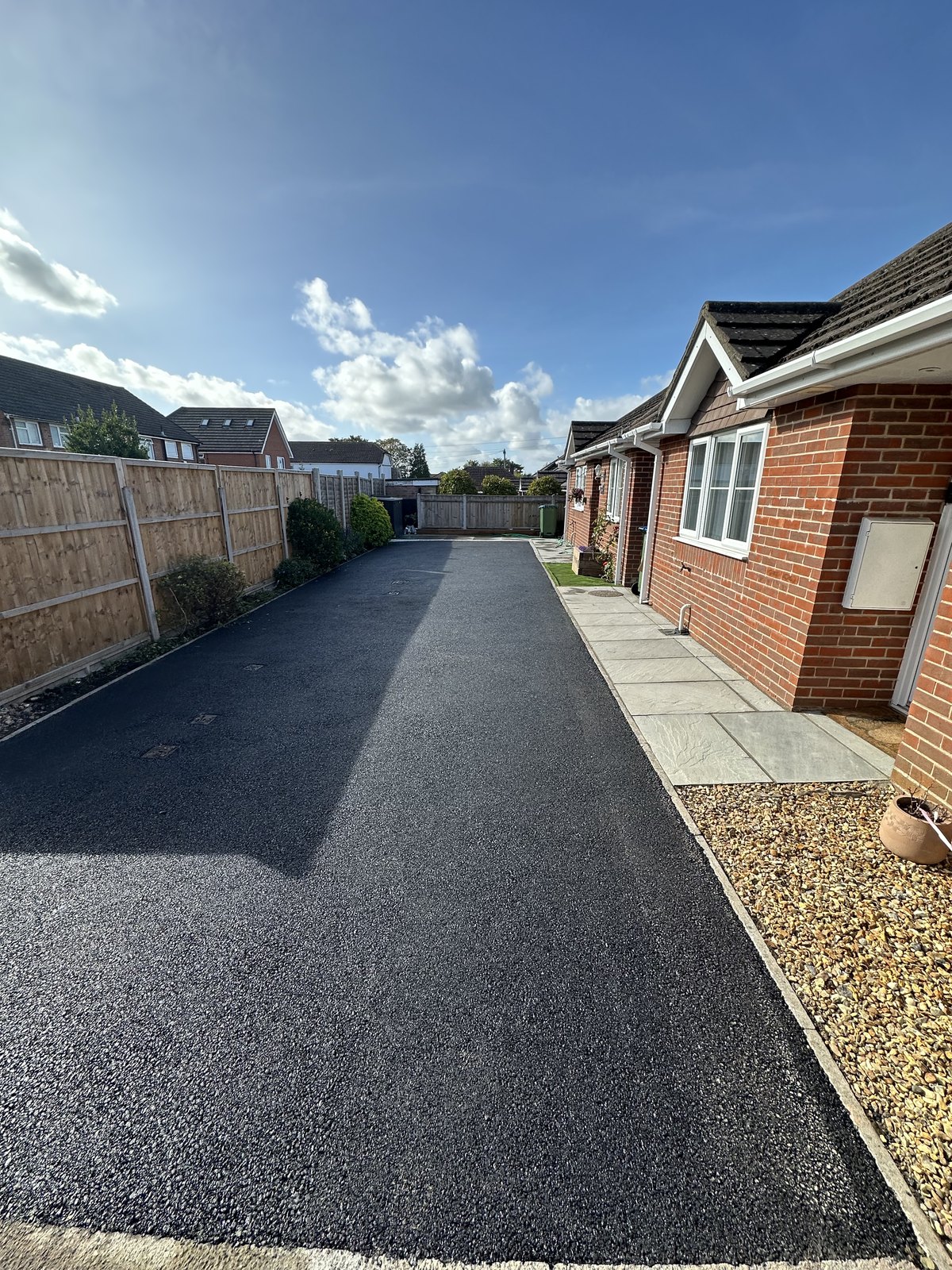
    Completed shared driveway in Southampton with a continuous new tarmac surface and reset utility covers.
    The finished driveway
    350 mmApproximate dip at the centre
    62 m²Approximate area rebuilt
    15 yearsOf sinking before the repair

    01 / The transformation

    Same driveway.
    A different finish.

    The original shared access had a worn, patched surface and uneven areas. We rebuilt approximately 62 m² to restore the driveway’s levels and give the residents a consistent new tarmac surface.

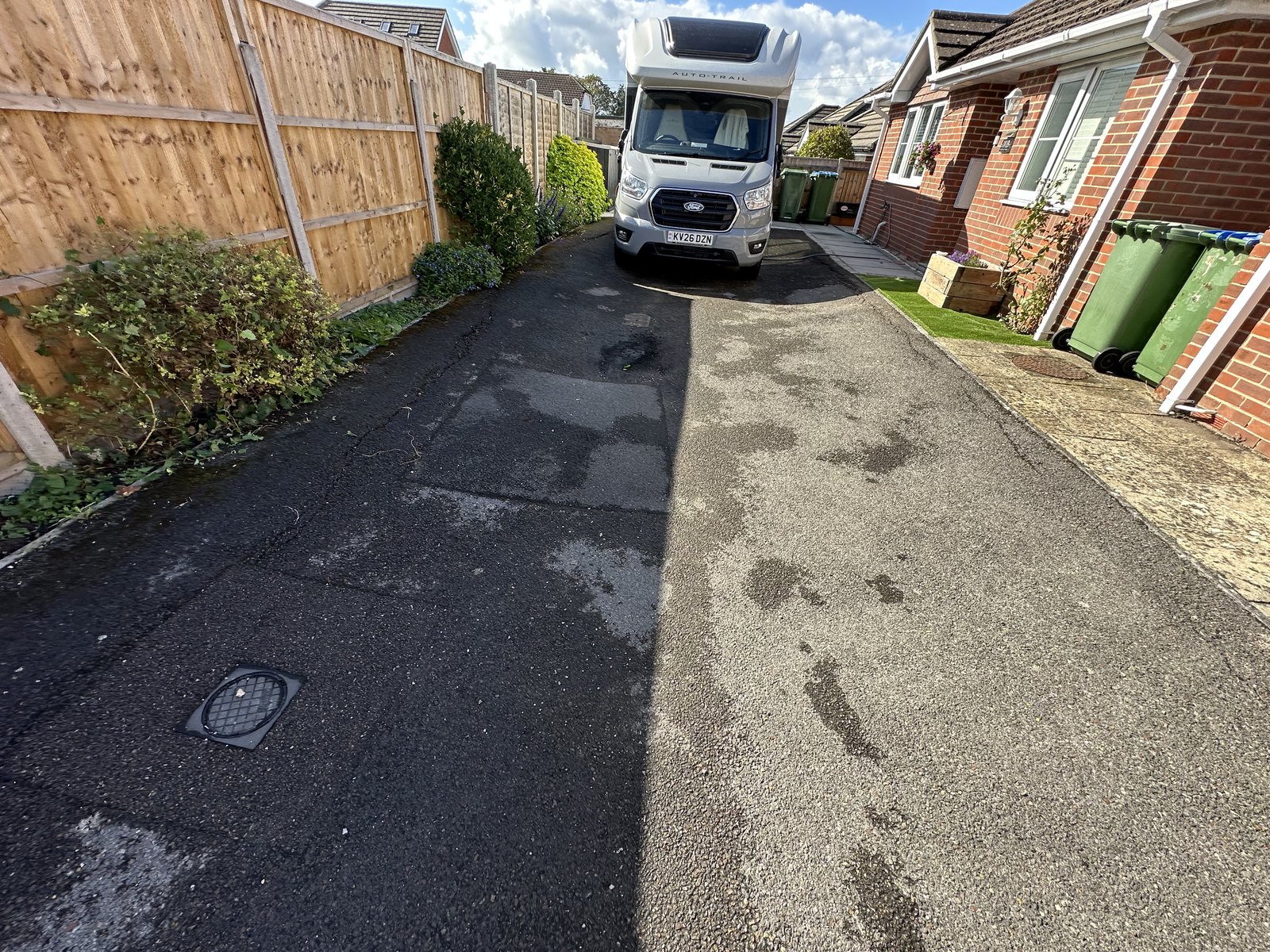
    Shared driveway in Southampton before repair, showing worn, patched tarmac and uneven areas.Before
    The worn shared driveway before the repair.
    Completed shared driveway in Southampton with the final wearing course laid and utility covers reset.After
    The completed driveway, with the final wearing course laid.

    02 / Beneath the surface

    A fresh finish starts
    with the foundation.

    1. Remove the old tarmac

      We excavated the existing tarmac across the repair area. It was removed from site by lorry and taken directly to a recycling plant.

    2. Stabilise and rebuild

      Terram geotextile fabric was laid across the full area as part of the ground stabilisation work. We then installed Type 1 sub-base, compacting it in 75 mm layers to form the foundation for the new surface.

    3. Reset the service covers

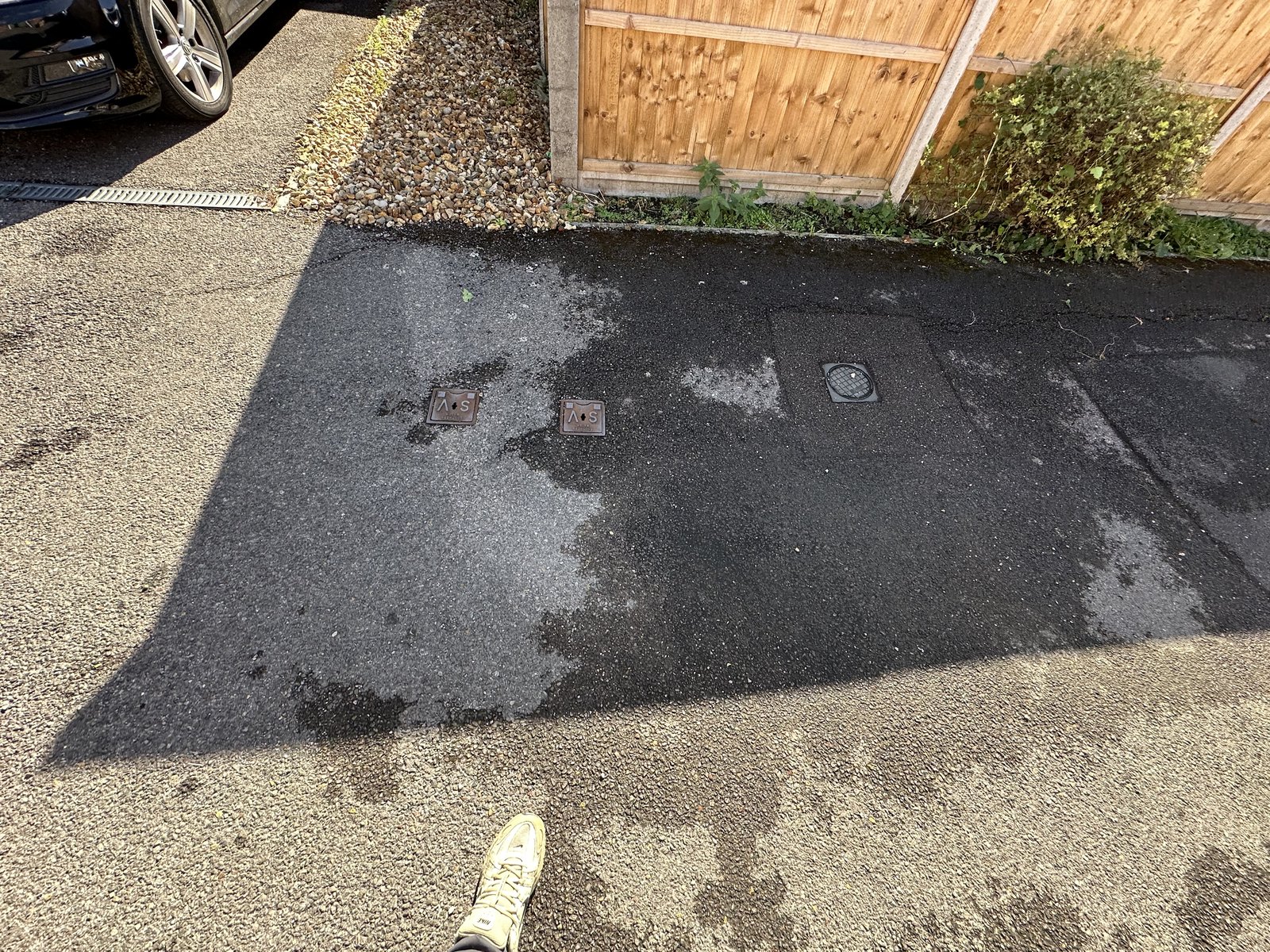
      The existing water stopcock and fire hydrant covers needed to match the new finished levels. We reset them on concrete bases so they were incorporated into the rebuilt driveway.

    4. Lay and compact the tarmac

      A 50 mm base course, using 20 mm tarmac material, was followed by a 30 mm wearing course, using 10 mm material. The base was power-plate compacted; the wearing course was finished with a roller and power plate.

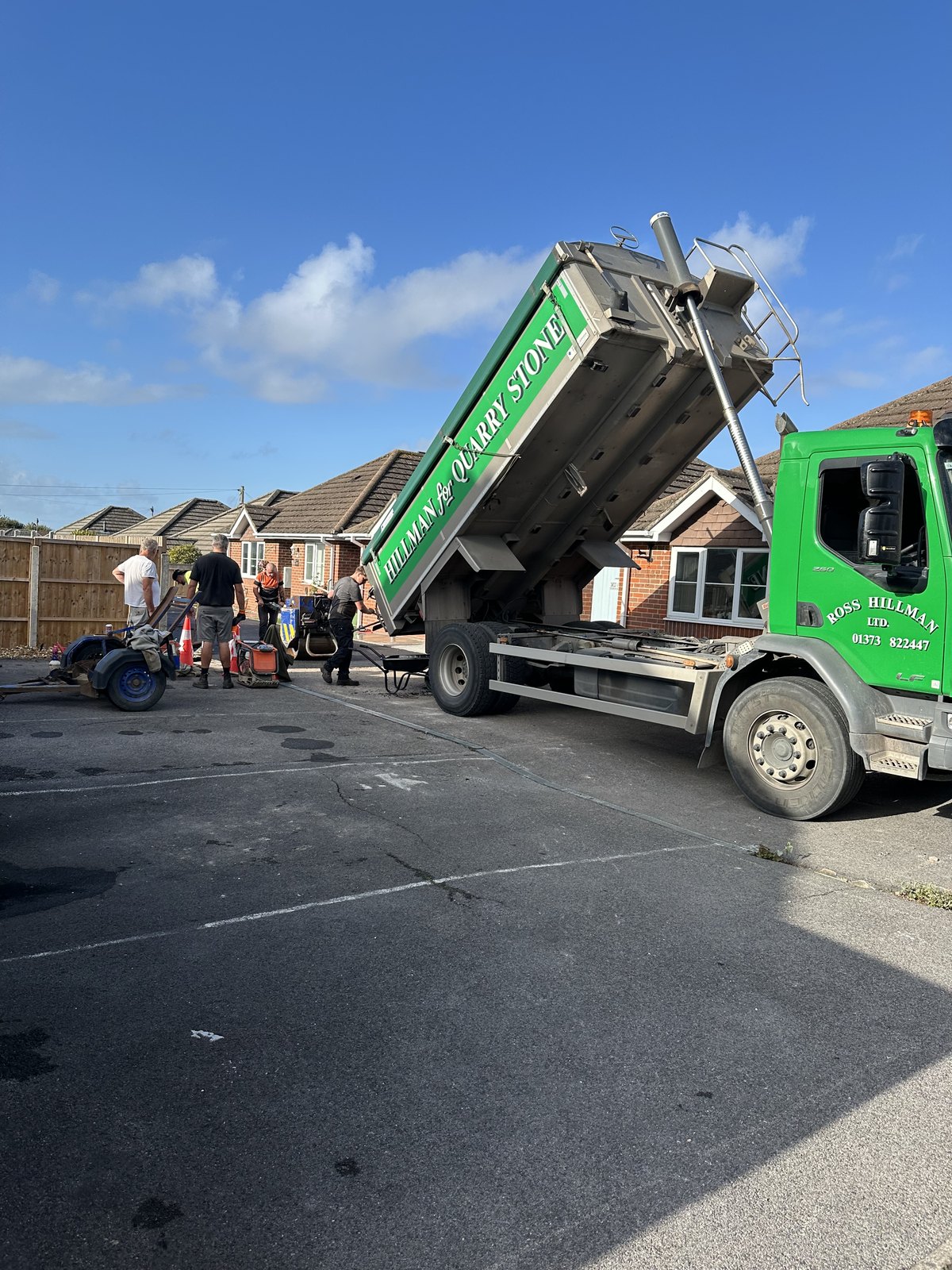
    Crew, tipper lorry and compaction equipment during the shared driveway repair in Southampton.
    During the work: the team and surfacing equipment on site.
    Built in layers

    Terram geotextile → compacted Type 1 sub-base → 50 mm tarmac base course → 30 mm tarmac wearing course.

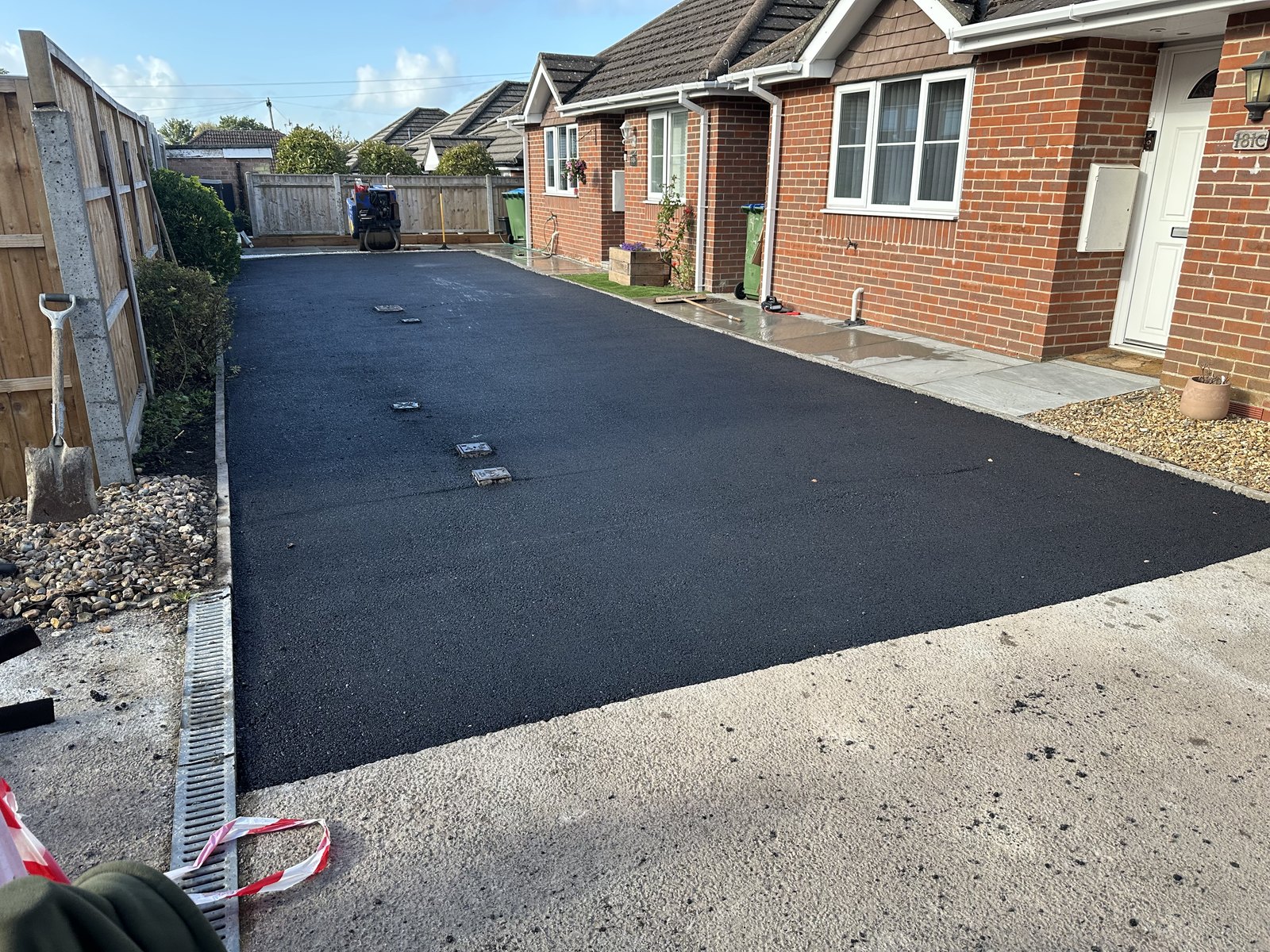
    The driveway base course laid in Southampton before the final wearing course, with a roller still on site.During / Base course
    Work in progress: the base course, before the final wearing course.

    Work in progress

    Base course in place

    This photograph shows the laid base course. The final 30 mm wearing course had still to be installed at this stage.

    03 / The finished details

    The whole surface.
    The small details.

    The finished tarmac runs between the existing fence and the homes, with the utility covers set into the new surface. The wearing course is the top layer visible in the completed photographs.

    Completed shared driveway in Southampton with a continuous new tarmac surface and reset utility covers.Finished
    The completed shared driveway.
    Worn and patched tarmac around utility covers on the shared driveway in Southampton.Before / The detail
    The existing utility covers and patched surface before the rebuild.

    This Southampton project shows the work that goes into a driveway repair beneath the finished surface: removal, ground preparation, compaction and attention to the existing covers, followed by the new tarmac.

    Let’s talk about your driveway

    Is your driveway sinking?

    If your driveway has developed dips, cracks or uneven levels, we can assess the existing surface and provide a quotation for the appropriate repair.

    Explore our tarmac surfacing services or see more completed surfacing projects.

  • Dropped Kerb Applications Made Clear: Track Every Stage with Irvine Surfacing

    Applying for a dropped kerb can involve several stages, different documents and communication with the relevant local authority. For customers, the most frustrating part is often not the work itself—it is waiting without knowing whether the application has been submitted, what stage it has reached or what needs to happen next.

    Irvine Surfacing has created a clearer way for our customers to follow the process: one private dropped-kerb application tracker across the different local-authority processes we manage, included with our service.

    When we manage your dropped-kerb application, you receive private access to our application tracker. Using your Irvine Surfacing application reference and postcode, you can check the latest recorded stage, see what happens next and stay informed without repeatedly calling or emailing for an update.

    It is designed to save everyone time while giving customers reassurance throughout the application process.

    Why dropped-kerb applications can feel complicated

    Before a vehicle crossing can be installed, the appropriate permissions and highway requirements normally need to be dealt with. The precise process varies between local authorities and may involve an initial application, supporting information, inspections, contractor approval and a separate highway licence or permit.

    These steps are important, but they can make it difficult for a customer to understand the overall position.

    Common questions include:

    • Has my application been submitted?
    • Has the council responded?
    • Is any further information required?
    • Has the application been approved?
    • Is a highway licence still needed?
    • What happens next?
    • When can the physical work be scheduled?

    Our tracker brings the latest information recorded by Irvine Surfacing into one clear customer view.

    One clear place to check your application

    Every application managed through Irvine Surfacing is given its own application reference.

    Customers use that reference together with their postcode to securely identify their application. The tracker then shows the latest stage recorded by our team and explains the next step in plain language.

    Depending on the application, the stages may include:

    • Initial information being prepared
    • Application submitted
    • Awaiting local-authority review
    • Further information requested
    • Site inspection required
    • Approval received
    • Highway licence or permit in progress
    • Works ready to be scheduled
    • Installation completed

    The aim is simple: you should not need to understand several different council systems just to find out what is happening with your own application.

    How the application tracker saves time

    Without a clear tracking system, both customers and contractors can spend a considerable amount of time answering and sending update requests.

    A customer may call because they are unsure whether the council has replied. The contractor then needs to check emails, application records and local-authority correspondence before responding. The same process may be repeated whenever the customer wants another update.

    Our tracker reduces that unnecessary back-and-forth.

    Instead, customers can quickly check the latest recorded position for themselves. Our team can spend more time progressing applications and arranging work, while customers have a convenient source of information available when they need it.

    It also creates a clearer record of the process, reducing the likelihood of crossed messages or uncertainty about which stage has been reached.

    Reassurance at every stage

    A dropped-kerb application can take time, particularly when the relevant authority needs to carry out checks, arrange an inspection or request further information.

    Waiting is easier when you know why you are waiting.

    The Irvine Surfacing tracker is designed to show both the latest recorded stage and what is expected to happen next. That could mean awaiting a council decision, preparing additional documents, obtaining a permit or moving towards scheduling the installation.

    It does not promise a council decision date that is outside our control. Instead, it provides an honest and useful view of the information currently available to our team.

    That transparency gives customers greater confidence that their application has not been forgotten and that the necessary steps are being managed.

    We handle the application administration at no extra charge

    When Irvine Surfacing is appointed to complete your dropped-kerb work, we prepare, submit and manage the relevant application administration as part of our service.

    There is no additional Irvine Surfacing administration fee for handling that paperwork.

    Our team can:

    • Prepare and submit the relevant application
    • Liaise with the local authority or highway team
    • Respond to routine requests for application information
    • Help coordinate inspections where required
    • Manage the necessary paperwork through the relevant stages
    • Record progress clearly within your customer application tracker

    This removes much of the administrative burden from the customer and helps ensure that the information is handled consistently.

    Third-party charges are separate. Any council application fees, statutory charges, inspection costs, highway licence fees or permit fees imposed by the relevant authority remain payable where applicable. We will make these separate costs clear so they are not confused with our works price or our free administration service.

    One consistent experience across different local-authority processes

    Individual councils may use different application routes, forms and online systems. That can be confusing, particularly when customers try to follow the process themselves.

    Our tracker provides one consistent Irvine Surfacing customer experience across the local-authority processes we manage.

    Rather than asking customers to interpret several different systems, we record the relevant progress in a simple format. Customers only need their Irvine Surfacing application reference and postcode to see the latest information available to them.

    The tracker does not replace the local authority or influence its decision. Applications, approvals and processing times remain subject to the relevant council or highway authority.

    What it does provide is a much clearer way for customers to understand where their own application stands.

    From initial quotation to completed dropped kerb

    The tracker forms part of Irvine Surfacing’s wider dropped-kerb service.

    We can help from the initial site discussion and quotation through to the application, permissions, scheduling and physical installation. Where driveway or access work is also required, we can provide a coordinated quotation for the complete project.

    Our focus is on making the process as straightforward as possible:

    • A clear quotation
    • Application administration included
    • Private progress tracking
    • Straightforward updates
    • Experienced surfacing and vehicle-access installation
    • One team managing the project from application to completion

    Planning a new dropped kerb?

    If you are considering a dropped kerb or vehicle crossing, Irvine Surfacing can assess the proposed access, explain the likely application requirements and provide a clear, no-obligation quotation.

    Once instructed, we will handle the application administration and give you access to our private tracker, helping you stay informed from submission through to the installation of your new vehicle access.

    Request your free dropped-kerb quotation or contact Irvine Surfacing to discuss your property.

    Tracker information reflects the latest progress recorded by Irvine Surfacing. Application decisions, inspections, licence requirements and processing times remain under the control of the relevant local authority.

  • Tarmac, Resin or Block Paving: Which Driveway Surface Is Right for You?

    Choosing a new driveway surface is about more than appearance. The right option needs to suit the property, the way the driveway will be used, the available budget and how much ongoing maintenance you are comfortable with.

    Tarmac, resin bound surfacing and block paving can all produce an excellent driveway when the preparation, drainage and installation are handled correctly. This guide explains the practical differences to help homeowners across Reading, Berkshire and the surrounding area make an informed choice.

    Start with how the driveway will be used

    Before selecting a finish, consider the size and shape of the area, how many vehicles will use it, whether the ground slopes towards the house and whether you want a simple practical surface or a more decorative design. The condition of the existing base matters too. A long-lasting driveway depends on suitable excavation, a well-compacted sub-base and sensible water management.

    Tarmac: practical, durable and cost-effective

    Tarmac surfacing is a strong all-round option for driveways, private roads and larger access areas. Its clean, understated finish suits both traditional and modern properties, while contrasting block-paved edges can add definition.

    • Well suited to larger driveways and areas with regular vehicle use
    • Usually quicker to install than individually laid paving
    • Creates a neat, practical surface with relatively low maintenance
    • Can be finished with decorative edging and clearly defined drainage

    Tarmac is often the best fit when durability, value and a straightforward appearance are the priorities.

    Resin bound: smooth, decorative and permeable

    Resin bound surfacing combines natural aggregate with a clear resin to create a smooth decorative finish. It is available in a wide range of aggregate colours, making it easier to complement brickwork, landscaping and the character of the property.

    • Premium appearance with a choice of colours and blends
    • Smooth finish without loose stones
    • Permeable when installed as part of a suitable porous system
    • Works well for driveways, paths, patios and detailed shapes

    The base must be assessed carefully. Resin should only be laid over a stable, appropriate surface, and the complete build-up needs to manage water correctly.

    Block paving: flexible design and strong kerb appeal

    Block paving is a versatile choice for homeowners who want more control over colour, pattern, borders and detailing. Individual blocks can also be lifted and replaced if access beneath the driveway is ever required.

    • Wide range of colours, sizes, patterns and border details
    • Ideal for creating a distinctive or traditional appearance
    • Individual damaged blocks can be replaced
    • Requires occasional cleaning and joint maintenance

    Good preparation is essential. The blocks rely on a stable sub-base, accurate levels and correctly restrained edges to prevent movement.

    Quick driveway surface comparison

    Surface Best for Appearance Maintenance
    Tarmac Practical driveways and larger areas Clean and understated Low
    Resin bound Premium decorative driveways and paths Smooth with many colour choices Low to moderate
    Block paving Bespoke patterns and detailed designs Traditional or contemporary Moderate

    Do not overlook drainage and access permission

    Driveway levels and drainage should be planned before the finish is chosen. Surface water should not be directed onto the pavement, road or towards the building. Requirements can depend on the size of the area, the chosen construction and local conditions, so professional assessment is worthwhile.

    If the project also requires a new or widened vehicle crossing, the dropped kerb and any necessary council approval should be considered at the start rather than after the driveway has been completed.

    Which surface should you choose?

    Choose tarmac when you want a durable, practical surface and good value across a larger area. Choose resin bound when a smooth premium appearance and colour choice are most important. Choose block paving when bespoke patterns, borders and traditional kerb appeal are the priority.

    The best recommendation still depends on the property itself. Irvine Surfacing can assess the existing ground, drainage, access and intended use before providing a clear specification and quotation.

    Need help choosing your driveway surface?

    Arrange a free site visit and no-obligation quotation for your property in Reading, Berkshire or the surrounding area.